The player's guide
How to run an outfit
You don't drive. You own the cars, hire the people who do, tell them how to fight, and decide where they go. Then the clock runs, the fights happen, and you live with the results. This guide assumes you've never played anything like it.
The idea
Steel Highway is built on a classic tabletop game of armed cars: every car is designed part by part from a rulebook, and every fight is played out turn by turn, a fraction of a second at a time, with dice deciding every shot, skid and crash. You never roll those dice. The game's engine plays every fight on its own, using your car, your crew and your orders.
So the game is the business around the fights:
- Design or buy cars: what guns, how much armor and where, how fast, how heavy, how expensive.
- Hire crew and keep them alive, paid and improving.
- Give orders: how aggressive, at what range, who to shoot first.
- Pick your fights: arena heats for prize money and fame, courier jobs on the road for steady cash.
- Pay the bills: salaries, repairs, ammunition, entry fees, the road.
Every fight leaves a full replay and a combat log, so you can watch what happened and work out why.
Your first week
- Found an outfit. Name it and pick a home town. Your home is where your own mechanic works, and where cars with nowhere else to be are parked.
- Get a car. The easy way: buy a stock car off the lot in the Garage. It's complete, legal and ready. The interesting way: open the Design Studio and build one from a bare body. Keep your first car under $10,000 so it fights in Division 10 against other beginners.
- Hire a driver. Crew → Free agents. A car can't move without one. Put them in the driver's seat from the garage card. A gunner is the best second hire if the car has more guns than the driver can fire.
- Set the orders. Every car has a Tactics page. If you're not sure, pick a style ("Balanced" is a fine start).
- Pick a fight. On the arena card, sign up for a heat in your division at an arena your car can reach before sign-ups close (a day before the fight). Or take a courier job from the job board in your town.
- Watch it, then fix it. Read the recap, watch the replay, repair and reload at a Mama Kessel's, and adjust.
The arena pays better and makes you famous. The road pays steadily and teaches your crew. Most outfits do both.
The clock
The game runs in real time: one game day is one real day, on Eastern time, and the calendar says 2047. Fights happen at their scheduled time whether you're watching or not; trips take real hours; contracts run for real weeks.
- Fight nights: every arena fights once a week. Tuesday Hangar Nine, Wednesday Pad Zero, Thursday Dead Mile, Friday the Furnace Bowl, Saturday the Copper Pit, Sunday the Refinery Oval.
- Monday at 4 am the week turns over: salaries are paid, contracts tick down, the new card goes up.
- Your inbox (the bell at the top) tells you when anything happens: a fight result, a trip arriving, a job paid, someone hurt. You can have it emailed.
Cars
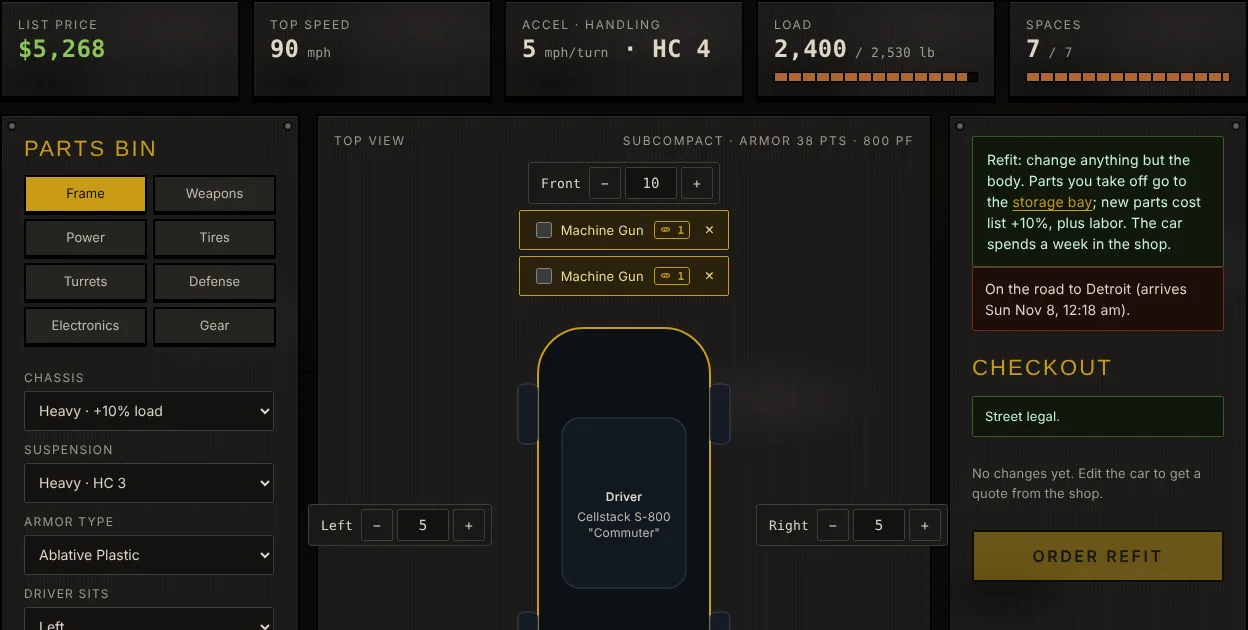
A car is a body (from a subcompact to a van), a chassis and suspension, a power plant (everything is electric now), tires, weapons, armor and gear. Every part has a price, a weight and a size. The studio adds it all up and tells you if the car is legal.
- Weight and load
- Each body can carry so much. Too heavy and it isn't legal; heavy cars are also slow.
- Spaces
- Room inside for guns and gear. Each body has a fixed number.
- Top speed and acceleration
- From the power plant against the weight. Speed makes a car harder to hit and lets it run.
- Handling (HC)
- How hard the car can be thrown around before it skids. Better suspension, better HC. Every swerve and every hit costs handling for the turn; run out and the driver has to roll to keep control.
- Armor
- Points on each of six sides: front, back, left, right, top and underbody. Hits come off the armor on the side they land; when a side is gone, the next hits go into the car: its engine, its guns, its crew.
- Weapons and arcs
- A gun points one way: front, back, left or right, or in a turret that turns. It can only shoot at what's in front of it. Front guns suit a car that charges; back guns and dropped weapons (mines, spikes, oil, smoke) suit a car that's chased.
- Damage points (DP)
- How much a part can take before it's destroyed. Tires have them too: lose one and handling collapses.
- Value
- What the car is worth decides its division: up to $10,000 is Division 10, up to $25,000 is Division 25, anything is the Open.
A first car that works: a compact or mid-size, one or two machine guns up front, a medium power plant, heavy-duty tires, and most of the armor on the front and sides. Don't spend everything on guns: an unarmored car is a short fight.
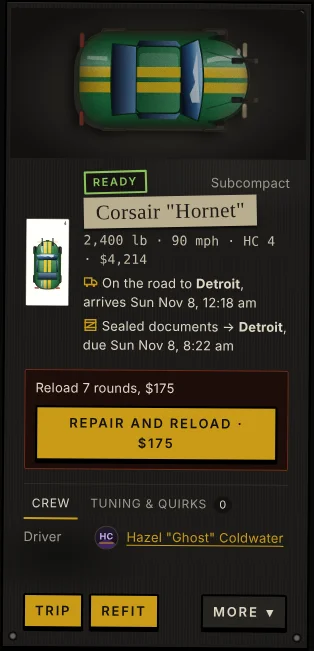
After a fight, the garage card shows the bill. Repairs and reloads need a Mama Kessel's in the car's town. A built car can be refitted (anything but the body), and mechanics can take on projects that improve it for good. The workshops sell rare upgrades.
Crew
Every seat is a hired person with skills. Skills have levels: a "base" level means trained, and each +1 above it is better.
- Driver
- Steers the car. Better reflexes, better control rolls, more risk they can take. Every car needs one.
- Gunner
- +1 to hit for each level. Untrained, they shoot at −3. Each person fires one weapon (or one linked set) a turn, so a car with several guns needs more than a driver.
- Mechanic
- Cheaper repairs and refits, projects on your cars, patching armor on the road.
- Paramedic
- Keeps the dying alive and heals the hurt faster. One in the outfit saves lives.
- Others
- Handgunner (hand weapons), Running (getting clear of a wreck), Luck (a second chance at a lost control roll), Streetwise (better prices), Route Sense (slipping past trouble on the road).
- Contracts are 4, 8 or 12 weeks: a signing fee, a weekly salary and a share of the car's winnings. Miss a payday and they walk. You can re-sign them in their last week.
- Experience: crew earn skill points in every fight and job, and can be sent to training.
- Wounds: a crew member can take three. One hurts, two knocks them out, three is death, unless the crash crew get there first (a paramedic makes that likelier). The hurt heal day by day, faster with a medic.
- Gear: the gear locker sells body armor, sidearms, medikits and tool kits. Armor soaks hits; medikits make medics better; tool kits let mechanics patch on the road.
- Clones: the Lazarus Clinic will keep one on file, for a price. If they die, the clone wakes up, minus whatever they learned since it was made.
Orders
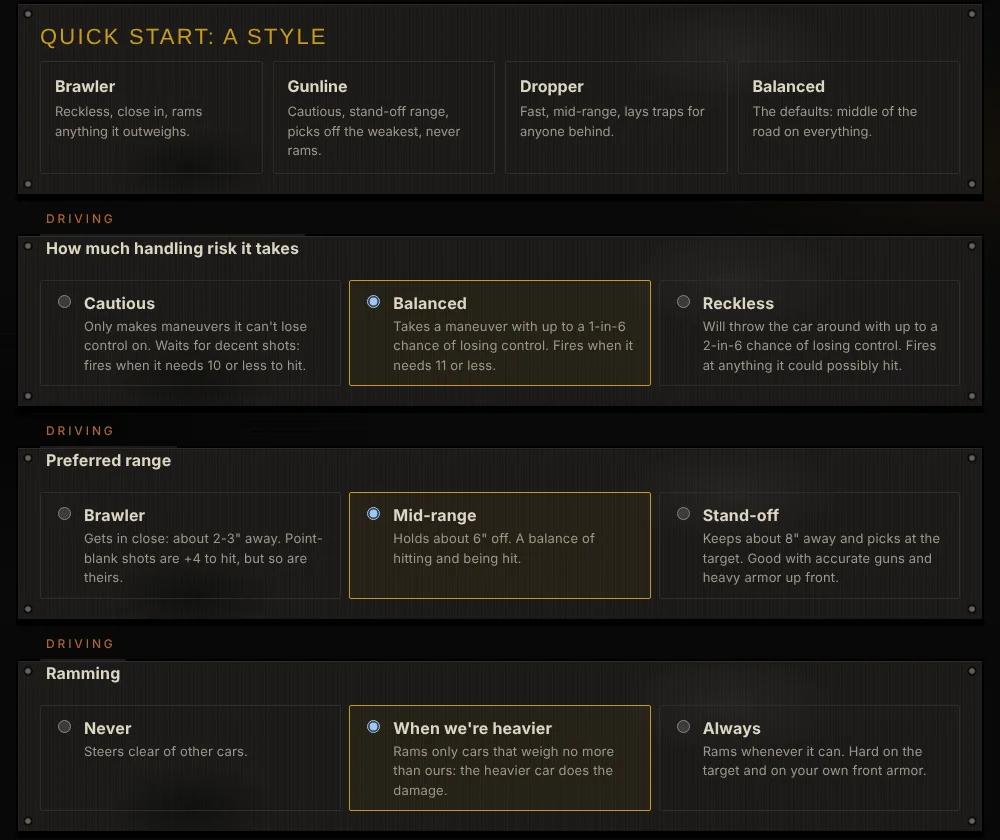
Your crew fight the way you tell them to. Each car has standing orders:
- Risk: cautious drivers never lose control and only take good shots; reckless ones throw the car around and fire at anything.
- Range: brawlers get in close (easy to hit, easy to be hit); stand-off cars hang back with accurate guns.
- Target: the nearest, the weakest, the strongest, or whoever hit you last.
- Aim: the weakest side, the tires, the turret, or the driver's side.
- Ramming, when to break off, dropped weapons and cruising speed.
Orders are read when the car signs up and frozen for that fight. Match them to the car: a reckless brawler in a lightly armored car dies young.
How a fight works
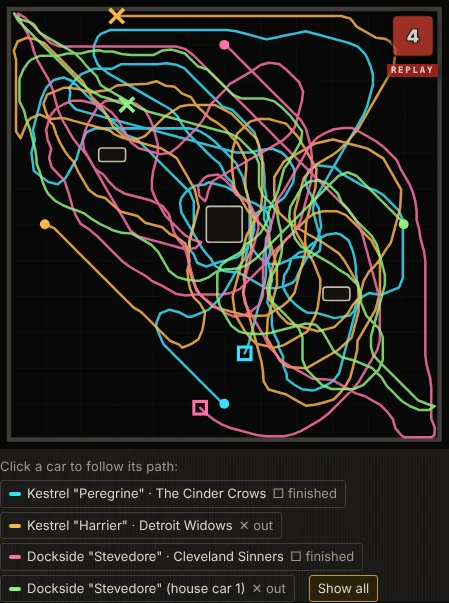
A fight is a series of turns, each one second long and split into five phases. In each phase, cars move by fractions of an inch on the arena map; they turn, swerve or brake (each maneuver has a difficulty that costs handling); then the crews fire.
- Shooting: every shot needs a number on two dice, made harder by range, speed and maneuvers and easier by skill and targeting gear. A hit rolls its damage onto the side it struck.
- Losing control: when a car runs out of handling, the driver rolls. Fail and it skids, fishtails, spins or rolls over.
- Collisions: ramming hurts both cars; the heavier one comes off better.
- Fire: burning cars take damage every turn, and cars carrying rockets or flamethrowers can explode.
- Out of the fight: a car is out when it's wrecked, nobody aboard is conscious, or it can't move or shoot.
- The end: the last car still fighting wins. If the bell goes (180 turns), or nobody does any damage for 30 turns, it's a draw.
The arena
- The card: each arena runs one heat a week (a second if it fills), in a division that rotates. Four to six cars.
- Signing up: the car must be in the arena's town, repaired enough to race, with a fit driver, and worth no more than the division allows. You pay the entry fee: $250 in Division 10, $500 in Division 25, $1,000 in the Open.
- The lock: sign-ups close a day before the fight. The promoter fills the empty slots with other outfits' cars, and the car stays in town until it's done.
- Paydays: the last car standing takes the purse (more on a draw, shared among survivors). A car that puts another out takes a kill bonus of 20% of the victim's value. Every car earns crowd money for every point of damage it deals, win or lose. Your crew take their share.
- Prestige: surviving, kills and wins build it. Sponsors, promoters and the best free agents look at it first.
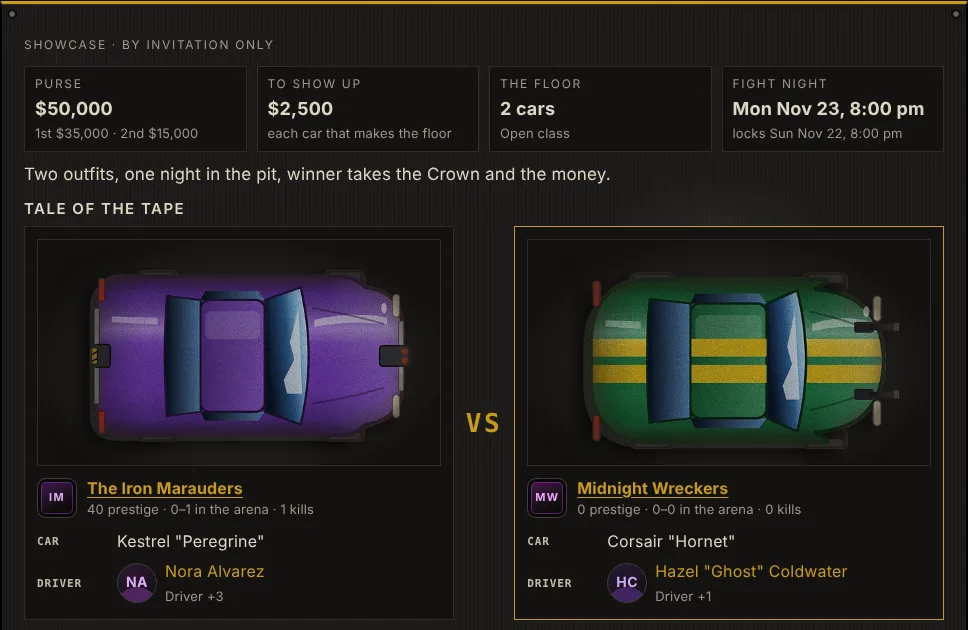
- Invitationals: promoters' special events, by invitation only, with big purses and an appearance fee. Accepting is a promise: no-shows pay for it.
- The book: Dot Pruitt takes bets on every heat once its card locks: a car to win, a car to survive, or the draw. With a car in the heat you can only back your own.
The road
- Travel: plan a trip from the car's travel page. Crews drive up to 12 hours a day and rest 12, in a town if they can (lodging for each head) or camped by the road. Recharging and lodging are paid when you leave.
- Pace: steady is safe; pushing it or flat out gets there sooner but wears the tires. Speed doesn't make the road safer, but it helps when you run.
- Trouble: the more dangerous the road, the more likely you meet something. Your standing orders decide what happens: run, fight, pay, or give up the cargo. Fights on the road are played out like arena fights.
- Jobs: courier boards in every town post parcels, freight and convoy escorts, with pay, a deadline and a bond. Deliver on time for the pay, the bond back and better standing; fail and you lose the bond and standing.
- Standing with each courier company unlocks better-paying jobs. Meridian and Night Freight don't like you working for the other.
Money
Coming in
- Purses, kill bonuses and crowd money
- Courier pay and road bounties
- Sponsor stipends (Peachtree Row, once you have the prestige)
- Invitational purses and appearance fees
- Salvage and selling parts
Going out
- Salaries, every Monday
- Repairs and ammunition
- Entry fees
- Lodging and recharging on the road
- New cars, parts, gear, training, clones
Every dollar is in the ledger (Garage menu): this week against last, week by week, by category and by car. Run out and crew walk, cars sit unrepaired, and the week gets long.
When you're established
- More cars: the garage holds six to start; more bays cost money.
- Sponsors on Peachtree Row pay a weekly stipend, a share of your prizes, and a bonus for a win in their home territory, if you keep your side of the deal.
- Stars: veterans and legends sign through the talent agency in Atlanta.
- Specialists: each territory's workshop sells upgrades nobody else has.
- And there are things nobody advertises. Do good work for the right people and you'll hear about them.
Words you'll see
- Turn / phase
- A second of fight time, split in five.
- Inch (")
- Distance on the fight map: every 10 mph is an inch a turn.
- HC
- Handling class: how much maneuvering the car can take in a turn.
- D1–D7
- How dangerous a maneuver or hazard is; it comes off the car's handling.
- Control roll / crash table
- The roll a driver makes when out of handling, and what happens when it fails.
- DP
- Damage points: what a part, a tire or a suit of armor can take.
- GE
- Grenade-equivalents: how much a crew member carries (six is the limit).
- Division
- The class a car fights in, by its value.
- Prestige
- Fame. Earned in the arena; lost by no-shows.
- Standing
- A courier company's opinion of you.
- Scratched
- Signed up, couldn't race.
- Linked weapons
- Identical guns on one side fired together by one crew member.
Questions
- Do I have to be online when my car fights?
- No. Fights run on schedule. Read the recap and watch the replay afterwards.
- Why did my driver do something stupid?
- Look at the orders. A reckless driver takes risks; a brawler gets close. Then look at the log: every roll is in it.
- My car is wrecked. Now what?
- Repair it at a Mama Kessel's in the car's town. A car that blew up is gone; one that's only wrecked can be fixed.
- Someone died.
- Unless they had a clone, they're gone. Hire someone new, and think about a paramedic.
- Can I lose the outfit?
- You can run it into the ground. Keep enough cash for Monday's salaries and a set of repairs.
- Where are the actual rules?
- Every ruling the game uses is written down; the pages tell you the numbers as you need them: the studio, the tactics page, the arena card, the travel planner.